When a student exists their formal education, sometimes it seems as if education has stopped and working must begin. However, people can retain and support a life long love of learning without having to attend formal education. For example, a group of people calling themselves Skeptics go to The Amaz!ng Meeting annually and hold various talks about an assorted collection of topics unified by the idea of Skeptical thinking.
This particular topic, Martial Arts, may well appeal to boys with an interest in martial arts and even more so for a child who reads comic books or watches various superhero movies. As a young boy, Superheroes had my admiration.
In the case of my daughter, being a particularly concerned father, I have sought to awaken and interest in martial arts within my daughter. My rational being: "Boys have an off button. If you hit it hard enough, often enough, they will get off you." My daughter has taken some classes in Kenpo with Jeff O'Donnell. As such, she might have a more than passing interest in the topic of martial arts and I can see some value in setting reasonable expectation of martial arts in her mind. The added bonus of explaining how martial arts is still science is just gravy.
An hour and a half of a panel might seem a bit long or a tad dull to someone who's interests do not align with the material. However, I enjoy it. I am watching it. I think that if the old adage of "Monkey See, Monkey Do" applies to children watching their parents, my daughter might enjoy it as well.
You may have heard of the Great River Road along the Mississippi River. Rivers, like roads, are useful for transportation. The Mississippi river represents a very long and very wide river road from St. Paul, Minnesota to New Orleans, Louisiana. The river, however, can be temperamental. Of course, rivers don't have emotions, but high flood or low water could make great difficulties in navigating goods on the Mississippi. Some people hatched an idea to fix this; they wanted a reliable 9 foot navigation channel.
The Chain of Rocks area is called this due to some quirks of geology. During a period of glaciation, the Missouri River changed course. The old path was some distance into what is now Illinois. The new, and current path, cut over hard limestone which created ridges and shelves of rock that make navigation tricky. The river, at this point, looked like a chain of rocks at low water.
To solve this navigation problem, the Chain of Rocks Canal was cut through Illinois in the 1940s for a length of 8.4 miles. The chain of rocks, the namesake of this area, are now usually submerged under water except for times of extreme low water due to a dam put in place to ensure the Chain of Rocks Canal had sufficient water.
The Chain of Rocks Bridge, built in 1929 predates the cutting of the Canal by the Army Corps of Engineers. This bridge possesses a strange feature in that it takes a 22 degree turn along the way. This turn was a compromise between putting the supporting foundation of the bridge on firm ground and enabling fee access down the river in the years before the Canal was built.
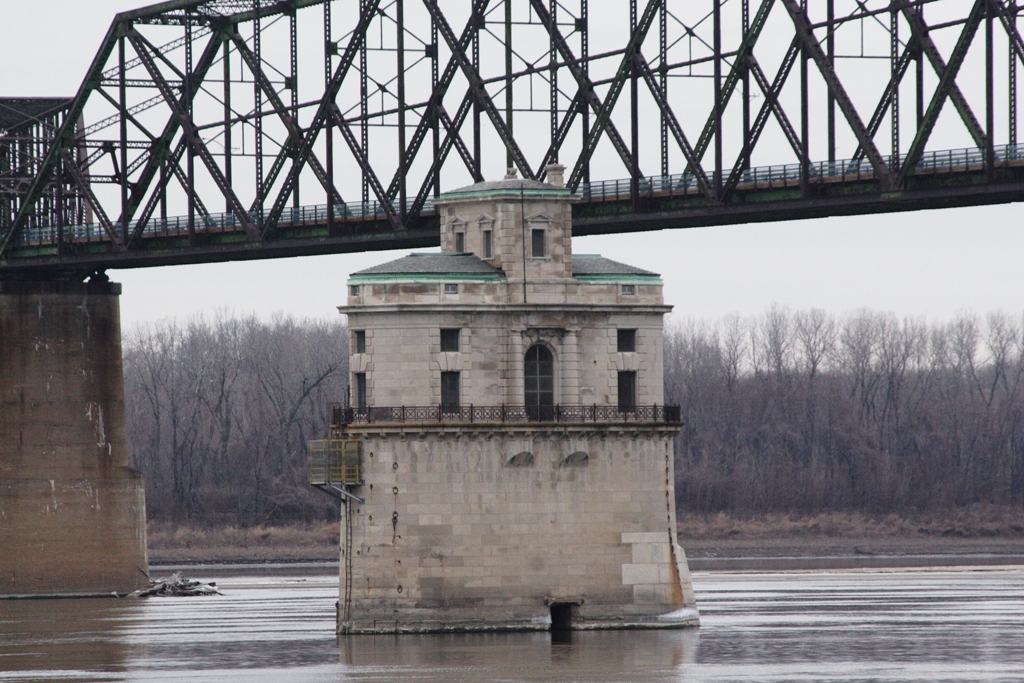
In 1967, Interstate 270 opened and the Old Chain of Rocks Bridge was retired. In languished in disuse for a while and developed a bad reputation for crime. Fortunately, Trailnet reopened the Old Chain of Rocks Bridge for pedestrian and bicycle traffic in 1999. From this location or while driving across Interstate 270 just north of the old bridge, you can see two 'castles' sitting in the river.
A brief video clip from KSDK.com Goes into the towers and explains them.
"Water Intake CoRB" by Original uploader was Rklawton at en.wikipedia - Transferred from en.wikipedia; transferred to Commons by User:Xnatedawgx using CommonsHelper.. Licensed under Creative Commons Attribution-Share Alike 3.0 via Wikimedia Commons - http://commons.wikimedia.org/wiki/File:Water_Intake_CoRB.JPG#mediaviewer/File:Water_Intake_CoRB.JPG
These were water intake towers and were once a source of pride. Fresh and clean drinking water seems like a simple thing for us in this modern age. Not always so. "This was built in the time when having good drinking water, safe drinking water was something that the citizens bragged about and not all cities had it," -- Curt Skouby, Water Commissioner Related to the delivery of water to the City of St. Louis are the various "towers" found throughout the city. One of these in the Compton Hill Water Tower. These were standing pipes of water that helped regulate water pressure in the days when steam power was used to push water to the citizens. Improvements have taken these land-locked towers out of use, but you can still visit the Compton Hill Water Tower and enjoy a nice view if you have good lungs and strong legs. If you wish to attempt such a climb, further details can be found on the Water Tower and Park Preservation Society's website.
5 miles south of confluence of Missouri and Mississippi Rivers
Named “Chain of Rocks” due to a large shoal or rocky rapids there.
Because of a low-water dam built by Army Corps of Engineers, only visible in extreme low water now.
Chain of Rocks Channel was cut in Illinois to avoid the Chain of Rocks Shoals.
“In the late 1940s and early 1950s the U.S. Army Corps of Engineers built a 8.4-mile-long (13.5 km) canal to bypass this treacherous reach.” [Wikipedia: Chain of Rock Bridge]
“The shoals were a severe navigational hazard, to the point that they were eventually bypassed entirely with the 8-mile-long Chain of Rocks Canal.” [Built St. Louis]
Opened: 1894
Purpose:
Originally single channel water intake from Mississippi
Water filtered and delivered to city.
"This was built in the time when having good drinking water, safe drinking water was something that the citizens bragged about and not all cities had it," ~ Curt Skouby
director of public utilities, the water commissioner
"It was built between 1913 and 1915," ~ Curt Skouby
"It was used as an intake tower to bring in water from the Mississippi into the Chain of Rocks." ~ Curt Skouby
"This was built in the time when having good drinking water, safe drinking water was something that the citizens bragged about and not all cities had it," ~ Curt Skouby
Someone was often here to operate the gates.
Coal bin inside for heat.
Neither of the intake towers are in use these days.
"We get out here two times, maybe three times a year," ~ Curt Skouby
Chain of Rocks Bridge
Constructed in 1929
Part of Route 66
Financed by tolls.
1967, I-270 built
Chain of Rocks Bridge closed
1981 “Escape From New York” filmed as 69th Street Bridge.
Bad reputation for crime on closed bridge.
1999, bridge reopened for bicycle and pedestrian traffic.
Builtstlouis.net provides some of the same information but has their own set of pictures which are very nice to look at.
Some more background can be gleaned on the Chain of Rock Bridge itself from the respective Wikipedia Entry.
City of St. Louis Water Division's entry on The Chain of Rock Plant might also be of some interest, although it doesn't specifically mention the intake houses.
Another tangentially related aspect of water supply in the City of St. Louis involves the Standpipe Water Towers that appear at various points in the city. The City of St. Louis Water Division also provides some information on this as well.
The Water Tower Preservation Society provides a history page specific to these one of these Standpipe Water Towers, the Compton Hill Water Tower. If you have good lungs and strong legs, you might want to visit.
The pursuit of education should be a life long love of learning. For this reason, and others, I generally do not look favorably on an education system that relies excessively on testing. Excessive testing spoils a child's enjoyment of education, does not impart that life long love of learning, and results in a system that educates more like the Hare than the Tortoise in Aesop's fable.
The Amaz!ng Meeting (TAM)represents one of the avenues for indulging in a life long learning process. Children may not be entirely interested in watching a person give a lecture, especially if they are not motivated to pay attention because there will be a test. However, I think there is some validity in asking my daughter to, as a homeschool student, watch these sorts of things.
Librarians and school teachers stress the importance of a parent reading to their children every day. Apparently, reading to your children is one of the very best things you can do for your children. Reading for your own enjoyment and allowing the child to see you read also helps accomplish this. Children learn what they live, as an old poem used to go.
Children will mimic, mirror, copy, parrot, etc... those things that they see us doing. For me this is an excellent reason for my son and daughter to see their father interested in watching lectures as well as reading for my own elucidation. (My daughter is already aware that her father reads "old, college level books" as she puts it.)
Back to The Amaz!ng Meeting. (Wikipedia) The James Randi Education Foundation sponsors this meeting which focuses on science, skepticism, and critical thinking. Teaching our children to value traits such as these would serve them well in the life ahead of them. Truth does not simply fall out of the sky and land in our brains. Truth requires a devotion and a discipline akin to religion. Without skepticism, the mind falls prey to motivated reasoning, confirmation bias, cognitive dissonance, and other assorted pit falls.
If one would like to read further on an example of where the pursuit of truth sans rational rigor has run amok, I may suggest reading Sir Walter Scott's Letters on Demonology and Witchcraft. Reading is always Core Language Arts credit, but you might choose to label this as Social Studies and be not unfounded in your designation.
Today, I would like to promote a video from The Amaz!ng Meeting in 2014 by Eugenie Scott entitled, "Playing with Deception." This video runs a convenient half hour duration and, coming from a conference devoted to science, skepticism, and critical thinking, you should be able to assign Core Science credit. I leave it to your own judgement if a test is required. A test can demonstrate that the student has payed attention and might provide motivation to focus their mind on the video. (Not everyone is self-motivated and self-directed.)
To that end, I am going to watch the video and provide a few questions that might suffice. You should watch the video yourself, I believe, to demonstrate to your student that the video and pursuit of knowledge in general are important for adults as well as children. If you do do, certainly, you can ask questions to highlight the parts of the video you, personally, found most meaningful. Should you do so, it would certainly be appropriate to comment to this article with your suggested questions.
1. Museumofhoaxes.com (actually hoaxes.org) lists four broad categories of deception: Fraud, Hoaxes, Pranks, and Urban Legends. Please label the definitions below with the appropriate category.
A. _____ are a deliberately deceiving act that has succeeded in capturing the attention of the public.
B. _____ are Popular Stories that are widely believed.
C. ____ are a criminal form of deception in which someone gets hurt.
D. _____ are playful acts performed between or among people who are acquainted with each other.
A. A medium from around the time of World War II. B. Built a house of crazy architecture because he believed ghosts told him to do so. C. A skeptic who has been offering a prize to any psychic able to convince him of their powers. D. An editor of a book of urban legends.
A. A fossilized hominid skeleton uncovered in the process of being eaten by a dinosaur.
B. The deadly Australian "Drop Bear."
C. A well known prank where a person is punched with a downward angle in the thylarctos plexis, a group of nerves that when hit causes uncontrolled passing of gas.
D. An example of a hoax.
4. "Oliver" was suspected of being a human-chimpanzee hybrid or "humanzee."
A. Because he was bald with a smaller head in proportion to his body and a flatter face and funny ears set high up on his head.
B. Because he was highly personable and displayed human-like use of silverware and cups as well as smoking cigars and drinking alcohol.
C. Because he was extremely personable with humans. D. Because he had a characteristically upright posture when walking. E. All of the above. F. People are gullible.
At some point in the distant past, I must have found and "liked" a video and subsequently a page on Facebook. This page is called, "The Periodic Table of Videos." Obviously, this is the kind of thing that would be right up my ally, loving science and all. Still, I have absolutely no memory of this. Odd.
As it happens, the University of Nottingham had a fire recently. This story seemed newsworthy enough for Facebook to push to my news feed. Lo and behold, I find that they have a YouTube channel listing 500 videos of a reasonably short duration each. Still, seems like an excellent mass of science videos for a student wishing to continue to gain Core Science Credit.
Now, if I may make a suggestion. I think you could do as I have done and get your child set up on a Google Drive account. Then, as they watch the videos, they can record the video name, the time, and write a paragraph or two about the video. This would allow them some experience working a word processing document (GoogleDoc), some time with writing that also helps firm up spelling as Google Docs will underline spelling errors, some hands on the keys with typing (which is a useful skill to possess), and some Core Language Arts: Composition experience while also giving you some easily accessed "Examples of Work."
I saw this math puzzle in my Facebook newsfeed. I've seen a similar one before regarding splitting up a bar of chocolate. Similar, in some ways, but different. First, the problem:
Some students might be clever enough to solve this without any help. Wonderful to have such a keen mathematically savvy mind. For those who don't, we don't want to frustrate them. The page from which I've drawn this puzzle provides a hint. If that is not enough, they also provide a more specific second hint.
However, if we are using this puzzle as a homeschool math assignment, we might want to milk it for educational value.
What is the name of this shape?
Presumably, the child will say it is a triangle. (Which is wrong, but we'll address that later.)
What are the dimensions of the red triangle?
3 by 8
The green?
2 by 5
Are the upper and lower red and green triangles the same?
The dimensions are the same. The upper and lower red and green triangles are coincident.
Are the orange and lime green irregular shapes also coincident?
Yes.
How many square units does the orange shape contain?
7. How many square unites does the lime green shape contain?
8.
How do you calculate the area of a rectangle?
A rectangle's area, the number of squares, is the height times the length.
How, then, do you calculate the area of a triangle?
A triangle's area is half the area of a rectangle with the same length and height. Basically, a triangle is a rectangle split evenly in half along the diagonal.
What is the area of the red triangle?
3 * 8 /2 = 12 cubic units. (Could be feet or inches, we don't know what the boxes represent.)
The green?
2 * 5 / 2 = 5 cubic units. What would the top shape, ABC's area be if we used the formula for the area of a triangle?
13 * 5 / 2 = 32.5
What would the top shape, DEF's area be if we used the formula for the area of a triangle and subtracted one cubic unit for the gap?
13 * 5 / 2 = 32.5 - 1 = 31.5 Add together the individual areas previously calculated previously. What is the true total area?
Orange = 7
Lime = 8
Red = 12
Green = 5
Total: 32
The Associative Law says that it doesn't matter in what order we add number together. Therefore, it shouldn't matter how we shuffle the shapes around. The actual area of the shapes as determined by adding the areas of the component parts is 32. Both of our calculations for the area on top and on bottom in the diagram are off by .5 cubic units, one greater and one lesser.
Assuming the formula to calculate the volume of a triangle is correct, and it can be shown to be correct by logic, we have a situation where the correct formula for the volume of a triangle does not result in the value calculated for the area. Therefor, the shape is not a triangle even though it looks like one.
The name of the diagonal line of a triangle is called the hypotenuse. We can express the hypotenuse as a ratio of the values of length and height. Therefore the hypotenuse of the red triangle is 3 high / 8 long. The hypotenuse of the green triangle is 2 high by 5 long. Dividing it out you get a ratio of 0.375 for the hypotenuse of the red triangle and 0.4 for the green triangle.
Confirmation Bias causes people to see what they expect to see. In the case above, we saw two shapes which were nearly triangular and assumed they were triangular. In actuality, the "hypotenuse" bows downward in the top figure and upward in the second every so slightly. This explains where the "hole" in the second figure comes from.
Of course the website from which I've pulled the puzzle provides their own solution, but I think it is nice to draw the children through the logic slowly. :) Hope your students enjoy! Now that they've worked through this logic problem, they might want to visit the infinite chocolate bar problem referenced previously.
Being a little late to the party, I wanted to promote a possible home school lesson plan involving the event. I will begin by visiting the site for The Rosetta Mission from the Jet Propulsion Laboratory's Facebook post.
Along the left side of the image you see above, there are a sequence of circles on the Rosetta Mission page. The first circle displays the image above, which is a beautiful and clear images of the comet called #67P. The next circle will take you to a video stream of the media event as Rosetta reached its destination. This is an hour and a 40 minutes of Core Science credit.
However, I think it would be a nicer introduction to the children to begin with the cartoon videos lower in the list. The third button from the top introduces the mission in a cartoon format running 4 minutes. It should be easily digested by even very young children. This provides background and a frame of reference for why we should be interested in the mission.
The fourth button will provide another two and a half minutes. This describes the mounting excitement as Rosetta wakes from her long slumber and prepared for her work. The process of aiming the satellite and adjusting speed and trajectory to match the comet must have required a lot of planing and precision from the European Space Agency. Watching this video helps build a sense of anticipation and importance.
For a little more detail, the following YouTube video can illustrate some of the degree of planning that goes into such missions. (2 minutes, no words.)
The Rosetta website also provides a link to a visualization of the flight of the Rosetta Mission. It is tucked away under a heading that asks, "Where is Rosetta?" which doesn't reveal the detail found by visiting the link. That is to say, it draws out the flight path of the mission which can further demonstrate the planning and, one hopes, inspire a student with the notion that some great things require a great amount of planning and patience to accomplish. (The child can look for astronomical navigation tricks like what appears to be a gravitational slingshot occurring in the early part of 2005. It might be interesting to ask they child if they can guess what is happening and why.)
The full progress of the visualization takes some time to complete. I don't have a timer to consult, but it appears as if the visualization runs at 1 day per second. The date range from 3/3/2004 to 8/4/2014. This web page allows calculation of a date range. If we trust the results, we come up with 3,806 days. Dividing by 60 results in about 63 minutes to watch the entire path. We should probably assume even the most ardent student will not possess that much patience. I'd time them and give them credit for the time they chose to spend on it, however.
If one wants to hurry past this part (reasonable, I think) you should still check out the Milestones. One of those milestones is Rosetta going into the long sleep mentioned in the video found at the fourth circle on the Rosetta home page referenced above. The following milestone occurs when "Sleeping Beauty" awakes.
The fifth circle continues to build expectation. One could skip this two minutes of "Are we there yet?" if one felt so inclined. I think there is some value in building expectation. For an enjoyable break, you might follow the link labeled "Competition Voting Open." Here you will see the photographs people who were eagerly anticipating Rosetta's arrival submitted for the "Rosetta, are we there yet?" campaign. Some should make you smile. You might also pique the student's interest in a small, related, art project.
Returning to the second circle down from the top, we have now should have sufficient interest raised. With all of the videos added together, we are getting pretty close to a full two hours of video time, all Core Science credit. I will admit that it seems as if the servers may be having some trouble today as I am writing this lesson plan. This might have to do with streaming video over from Europe or it might be an example of demand for the video exceeding the ESA's web server capacity. An alternate link to watch the video (it appears to be the same video) can be found at a LiveStream url. (If you skip ahead to 12:15 seconds in the LiveStream video you can skip a boring waiting period.)
You might be thinking that this is a lot of material to cover. However, from the "Mission" page there is so much more yet to explore.
Amazon Instant Video currently has "Magic Beyond Words: The J. K. Rowling Story" available for streaming for free with Amazon Prime membership. As such, this seems like a fairly good time to have a Social Studies unit on the author.
The movie will run for 1.5 hours, approximately. The movie has received less than favorable reviews, but one can overcome this with some patience and tolerance. Certainly, it is at an appropriate level for children who wish to see a glimmer into the life of the author of one of their favorite series of books and movies.
J.K. Rowling has her own website which might also bear a review adjacent to or subsequent to the watching of the movie depending on the setup of the home. A parent can load the website and navigate with the left arrow to the beginning of the timeline view. This presents a sequence of stories originating in 1965 when her parents met on a train. Details can be found on the timeline not apparent in the movie.
If your child, like mine, has voiced an interest in being a writer later on in life, they may have a degree of interest yet remaining for this topic. For a slightly different approach, we also have a British Documentary from 2007: J. K. Rowling: A year in the life..." This documentary might be a bit dry for younger audiences. One cannot, however, fault their dedication. (1 hr)
At the end of these three efforts at learning about the author, the student should have a better understanding of the author as a person. I like the idea of assigning a little creative writing as a review. This doesn't have to be particularly well defined. Ideas for the essay might be as follows:
What interesting details of J. K. Rowling's life most appealed to you? Specifically, what do you admire about her?
Rowling's life, like most lives, involves struggles. Her mother's illness. Pressure to pursue a practical or pragmatic career over her love of writing. How one confronts the difficulties in life builds their character. In what ways would you wish to be more like Rowling?
Have you learned anything about the life of an author or the process of writing? Would a career producing fiction appeal to you based upon what you've seen here? Not everyone can be a successful writer, the job requires creativity, ability, and persistence. Would you be able to write a full story? Would you worry if people will like it? If so, would those fears keep you from persisting? Even with a good book, selling the idea to a publisher can be challenging and require great patience. Can you see yourself sticking with your dreams despite setbacks?
The first serious relationship a woman has upon leaving her parent's home can seriously impact her life. She moved away from England to Portugal, why do you think she chose such a move? Her romance and marriage to her first husband went quickly. What caused the relationship to move so quickly and why did it fall apart?
People are imperfect, they do not always make ideal choices. The consequences of our decisions are not always evident while we are in the process of making life-choices. A gypsy wind blows J. K. Rowling from England to Portugal seeking for some change in life that will make her happy. She has experiences there; Memories are made. Yet, she also finds herself separated from family and friends who might have been able to advise or help.
Returning to England, she tries to rebuild her life. What obstacles created difficulties for her? What are your thoughts about the public aid system in place? How would you feel if you were in a similar situation? Into every life some rain must fall. Some people could have become complacent and resigned to being a part of the system of public assistance. One woman suggests having a second child to make it easier to live 'on the dole.' Certain hurdles made it difficult for Joanne Rowling to work. Her persistence, however, made it work.
Comparing the style of the movie, the website, and the documentary, which of the three appealed most to you? The timeline view allows more personal choice in which areas to explore more deeply. This may be far more interesting because it empowers the learner to focus where their interest is greatest. The the movie tries to present some of the facts with a sense of imagination and drama. The emotional content of such story telling can be more appealing and allow one to have better recall of details after the fact. The documentary will provide the most details, but can seem dry and a bit boring in the slow and methodical approach. It can be important to identify what seems to work best for the individual student. Further Options: