Thursday, February 12, 2015

Core: Science: Food Safety

As a homeschooling parent, you have the opportunity to tailor your child's education towards those areas most needed. For example, food safety. Understandably, some homeschooling parents are science averse. This may be due to a religious persuasion that requires a literal reading of Genesis or some strange belief that Jenny McCarthy is a better expert on vaccinations than a pediatrician.

Despite this, I think we can find common ground in valuing food safety. Bacteria are real. They can proliferate and get people sick. I might not be able to explain evolution to one who doesn't want to see it. I might not be able to convince people of the value of vaccinations. However, we can agree that bacteria exist and are sometimes associated with sickness. In the case of food poisoning, we should pretty much find a level of understanding.

To that end, the Food and Drug Administration has produced a perhaps cheesy video that is most likely appropriate for middle school children. The cheese factor helps dumb it down to a level that a kid might understand, which is nice. In the video, "Dr. X and the Quest for Food Safety" we find a nice exploration of concepts necessary to impress upon a young mind the concept of safe food handling. This, unlike other science lessons regarding the rate at which a body falls under the influence of gravity (although this a worthy subject), pertains to a subject which can immediately impact a child's life.

(Video: 45 minutes science credit)

For starters, an interest in safe food  handling does make one leery of eating at restaurants where one cannot watch the food preparation procedures. This is generally a healthy concern. Cooking your own food while paying attention to food safety rules is likely to keep a person healthy.  Generally being untrusting of restaurants will encourage one to prepare their own food. Preparing one's own food generally is more financially affordable and enables one to watch more closely their diet.

At the same time, the video manages to impart some nice scientifically respectable information regarding disease transmission with respect to unsafe food handling procedures. This is solid science credit with a practical application to a child's life. Bonus points.

The FDA has even gone farther than this one video. They have even put together an 100 page pdf booklet entitled, "Science and Our Food Supply." Thus, after watching the 45 minute video, you have a nice detailed PDF booklet for further reading. Some children digest this faster than others, but all the time spent going over this booklet is good, solid, core science credit.

For more scientifically advanced middle schoolers, you have a 110 page pdf booklet similarly titled, "Science and Our Food Supply."

The takeaway from this exploration of the FDA's website should be that some of the government agencies exist to safeguard citizens like you and me. These agencies might sometimes be opposed by certain vested interests more concerned with their profits than your health. However, if one is willing to follow the science instead of succumb to the song and dance of vested capital interests, these agencies can do an excellent work to protect us.



Monday, February 9, 2015

Core: Science: Inventing: Patients: USPTO Kids, an educational offering from the US Patient and Trademark Office

Credit: Core Subject: Science Time: Open Ended

Ideas come from unlikely places. You might find yourself humming a little melody and wrapping a few words around it. The spark of creativity and the process of creation can instill a sense of empowerment. Despite a world full of people, there remains room for ideas not yet considered.

Yet, without some discipline, a melody can fail to get recorded. If you don't fix it down upon paper in some form when an idea comes to you, your creation can sometimes roll away into the foggy recesses of your mind. For this reason, I like to encourage my daughter to record her thoughts and her stories. Pen and paper are better than the best memory and.. if for no other reason than nostalgia.. it might be nice to turn your mind back in time and re-read something you created years ago.

Every year, I also try to inspire interest in my daughter for participation in the science fair. Among the various types of science fair projects one can consider lies the engineering project. This is a lot like inventing something. What if your invention actually turns out to be reasonably useful? It can happen; great ideas can come from anywhere. Children, with a fresh outlook and fewer preconceived biases may just be able to look at a problem from a unique angle and those unique perspectives might result in a patentable product.

So how do that? Well, as a first step in this line of thinking I present to you a section of the United States Patents and Trademarks Office website: USPTO Kids.


The site is broken down into three levels for Kids, Teens, and Parents / Teachers. At the Parents level you can download an activity book for young children. Among other things, the  Teen section contains a PDF related to bio-mimicry as an inspiration for inventions. In the Kids section, one of the PDFs demonstrates building a model rocket. The site has many areas for a child to explore as their interests motivate them. 

While not everyone has the creativity to be an inventor, the field does not require any specific degree. Any child from any sphere of life with ambition, persistence, and a crafty mind could find themselves in possession of a bit of intellectual property drawing a little or a lot of income. The possibilities are open ended.

Wednesday, February 4, 2015

Language Arts or Social Studies: Reading with Essay: Hindu Tales from the Sanskrit

Hindu Tales from the Sanskrit


Reading is always core time, of course, but if you wanted reading and language arts time that you might be able to consider social studies, then this may be an option for you. I happen to enjoy reading public domain material on my Kindle. One such book is entitled, "Hindu Tales from the Sanskrit"[1] and it happens to dovetail quite well into home school lesson.

Perhaps, we could start with giving some respect to our friends and benefactors at Khan Academy. These are some people with both more competence and more industry than I possess. They happen to have a nice little introduction to the subject, "A beginner's guide to Hindu art and culture." This is free material and probably worth going over before reading the book as it gives a glimmer of insight into the culture behind the tales in the above mentioned book.

Returning to the book, "Hindu Tales from the Sanskrit," you have a series of fairy tales. However, the authors of the work very nicely added in their own study questions. If one has a slight exposure to Hindu culture, it is possible to understand the morality the fairy tales intended to convey.. particularly with the study questions to draw your attention to the most important points.

For example,
21. What would you have thought about this wonderful supply of food, if you  had been one of the woodcutter's children?
22. Was it a good thing for those children to have all this food without working for it? If not, why was it not a good thing?

As an example of a snippet from the story,
The secret he kept from the wife to whom he used to tell everything soon began to spoil the happiness of the home. The children who had no longer anything to do quarrelled with each other. 

By doing this, a child practices ...
  • Reading
  • Reading Comprehension
  • Ethics (Non-core time..)
  • Social Studies (Hindu)
  • Writing (The Essay Answers)
And, of course, experience with typing and using Google Documents if I am your teacher. :)

I  hope others will find this suggestion profitable and entertaining.

Saturday, January 10, 2015

Mathematics: Graphing Calculator: Desmos

Mathematics:
Desmos is a free online graphing calculator that includes tutorials in how to use it. It seems like this might be interesting for a child who had a curious exploratory nature. They have 30 or so little lessons if you click to "open calculator" and then click on the three horizontal lines in the upper left hand corner. These lessons include "sliders" for certain variables so one can visualize how the line changes as one makes adjustments to the underlying formula. 
Once a child has worked through the tutorials, they also have links from the home page (before "Open Calculator"). The "Staff Picks" links for math examples as well as art created through using equations, which should be intriguing.


Tuesday, September 30, 2014

Taking on Woo in Martial Arts, 1 1/2 hour Science Credit

TAM: James Randi Foundation: Skepticism: Science: Video: 1 1/2 hour Science Credit.


When a student exists their formal education, sometimes it seems as if education has stopped and working must begin. However, people can retain and support a life long love of learning without having to attend formal education. For example, a group of people calling themselves Skeptics go to The Amaz!ng Meeting annually and hold various talks about an assorted collection of  topics unified by the idea of Skeptical thinking. 

This particular topic, Martial Arts, may well appeal to boys with an interest in martial arts and even more so for a child who reads comic books or watches various superhero movies. As a young boy, Superheroes had my admiration. 

In the case of my daughter, being a particularly concerned father, I have sought to awaken and interest in martial arts within my daughter. My rational being: "Boys have an off button. If you hit it hard enough, often enough, they will get off you." My daughter has taken some classes in Kenpo with Jeff O'Donnell. As such, she might have a more than passing interest in the topic of martial arts and I can see some value in setting reasonable expectation of martial arts in her mind. The added bonus of explaining how martial arts is still science is just gravy.

An hour and a half of a panel might seem a bit long or a tad dull to someone who's interests do not align with the material. However, I enjoy it. I am watching it. I think that if the old adage of "Monkey See, Monkey Do" applies to children watching their parents, my daughter might enjoy it as well.

I hope yours do. 

Friday, September 26, 2014

Local History: Chain of Rocks Bridge: Water Intake towers.


You may have heard of the Great River Road along the Mississippi River. Rivers, like roads, are useful for transportation. The Mississippi river represents a very long and very wide river road from St. Paul, Minnesota to New Orleans, Louisiana. The river, however, can be temperamental. Of course, rivers don't have emotions, but high flood or low water could make great difficulties in navigating goods on the Mississippi. Some people hatched an idea to fix this; they wanted a reliable 9 foot navigation channel.

The Chain of Rocks area is called this due to some quirks of geology. During a period of glaciation, the Missouri River changed course. The old path was some distance into what is now Illinois. The new, and current path, cut over hard limestone which created ridges and shelves of rock that make navigation tricky. The river, at this point, looked like a chain of rocks at low water. 

To solve this navigation problem, the Chain of Rocks Canal was cut through Illinois in the 1940s for a length of 8.4 miles. The chain of rocks, the namesake of this area, are now usually submerged under water except for times of extreme low water due to a dam put in place to ensure the Chain of Rocks Canal had sufficient water. 

The Chain of Rocks Bridge, built in 1929 predates the cutting of the Canal by the Army Corps of Engineers. This bridge possesses a strange feature in that it takes a 22 degree turn along the way. This turn was a compromise between putting the supporting foundation of the bridge on firm ground and enabling fee access down the river in the years before the Canal was built. 

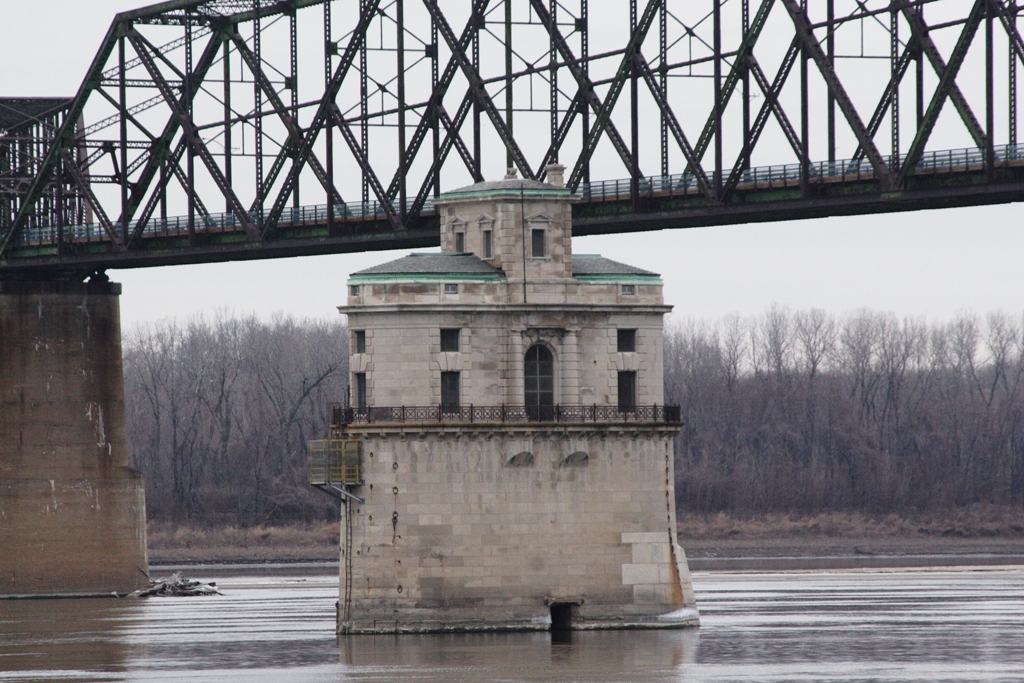
In 1967, Interstate 270 opened and the Old Chain of Rocks Bridge was retired. In languished in disuse for a while and developed a bad reputation for crime. Fortunately, Trailnet reopened the Old Chain of Rocks Bridge for pedestrian and bicycle traffic in 1999. From this location or while driving across Interstate 270 just north of the old bridge, you can see two 'castles' sitting in the river. 

A brief video clip from KSDK.com Goes into the towers and explains them.

"Water Intake CoRB" by Original uploader was Rklawton at en.wikipedia - Transferred from en.wikipedia; transferred to Commons by User:Xnatedawgx using CommonsHelper.. Licensed under Creative Commons Attribution-Share Alike 3.0 via Wikimedia Commons - http://commons.wikimedia.org/wiki/File:Water_Intake_CoRB.JPG#mediaviewer/File:Water_Intake_CoRB.JPG
These were water intake towers and were once a source of pride. Fresh and clean drinking water seems like a simple thing for us in this modern age. Not always so. "This was built in the time when having good drinking water, safe drinking water was something that the citizens bragged about and not all cities had it," -- Curt Skouby, Water Commissioner

Related to the delivery of water to the City of St. Louis are the various "towers" found throughout the city. One of these in the Compton Hill Water Tower. These were standing pipes of water that helped regulate water pressure in the days when steam power was used to push water to the citizens. Improvements have taken these land-locked towers out of use, but you can still visit the Compton Hill Water Tower and enjoy a nice view if you have good lungs and strong legs. If you wish to attempt such a climb, further details can be found on the Water Tower and Park Preservation Society's website.


Some notes:

  1. Chain of Rocks Water Treatment Facilities
    1. Chain of Rocks Plant
      1. Sources
      2. Location:
        1. 11 miles north of downtown St. Louis
        2. 5 miles south of confluence of Missouri and Mississippi Rivers
        3. Named “Chain of Rocks” due to a large shoal or rocky rapids there.
          1. Because of a low-water dam built by Army Corps of Engineers, only visible in extreme low water now.
          2. Chain of Rocks Channel was cut in Illinois to avoid the Chain of Rocks Shoals.
            1. “In the late 1940s and early 1950s the U.S. Army Corps of Engineers built a 8.4-mile-long (13.5 km) canal to bypass this treacherous reach.”  [Wikipedia: Chain of Rock Bridge]
            2. “The shoals were a severe navigational hazard, to the point that they were eventually bypassed entirely with the 8-mile-long Chain of Rocks Canal.” [Built St. Louis]
      3. Opened:  1894
      4. Purpose:
        1. Originally single channel water intake from Mississippi
        2. Water filtered and delivered to city.
        3. "This was built in the time when having good drinking water, safe drinking water was something that the citizens bragged about and not all cities had it," ~ Curt Skouby
      5. More reading: Further History
    2. Tower 1
      1. Sources
      2. Intake water tower No. 1 is closer to the Missouri side.
      3. Built in the early 1890s.
      4. Neither of the intake towers are in use these days.
      5. "They're similar in layout, but they're both unique," said Skouby.
    3. Tower 2
      1. Sources
      2. Closer to the Illinois side.
      3. Curt Skouby
        1. director of public utilities, the water commissioner
        2. "It was built between 1913 and 1915," ~ Curt Skouby
        3. "It was used as an intake tower to bring in water from the Mississippi into the Chain of Rocks." ~ Curt Skouby
          1. "This was built in the time when having good drinking water, safe drinking water was something that the citizens bragged about and not all cities had it," ~ Curt Skouby
        4. Someone was often here to operate the gates.
          1. Coal bin inside for heat.
        5. Neither of the intake towers are in use these days.
          1. "We get out here two times, maybe three times a year," ~ Curt Skouby
  2. Chain of Rocks Bridge
    1. Constructed in 1929
    2. Part of Route 66
    3. Financed by tolls.
    4. 1967, I-270 built
      1. Chain of Rocks Bridge closed
      2. 1981 “Escape From New York” filmed as 69th Street Bridge.
      3. Bad reputation for crime on closed bridge.
    5. 1999, bridge reopened for bicycle and pedestrian traffic.
      1. Funded by Trailnet.
    6. 22 degree turn
      1. Result of geologic shift in Mississippi River during glaciation.
      2. Old river bed lies to the east, in Illinois.
      3. Current river passes over resistant limestone.
      4. Bend was compromise
        1. Solid base for bridge.
        2. Access for river traffic.

Further Reading:
  1. Conor Watkins' Ozark Mountain Experience Article 4 Meet Me In St. Louis – Part II which disagrees with the video by implying the towers are still in use. Perhaps they were still in use when the article was written but have fallen out of use as indicated in the Video above.
  2. John Weeks III also provides a brief description of the Water Plant Intake Houses as well as a number of other articles under the heading of "Bridge Photography" and subheading of "St. Louis Area."  These include one on the Chain of Rock Canal and another on the Chain of Rocks Bridge.
  3. Builtstlouis.net provides some of the same information but has their own set of pictures which are very nice to look at.
  4. Some more background can be gleaned on the Chain of Rock Bridge itself from the respective Wikipedia Entry.
  5. City of St. Louis Water Division's entry on The Chain of Rock Plant might also be of some interest, although it doesn't specifically mention the intake houses.
  6. Another tangentially related aspect of water supply in the City of St. Louis involves the Standpipe Water Towers that appear at various points in the city. The City of St. Louis Water Division also provides some information on this as well.
  7. The Water Tower Preservation Society provides a history page specific to these one of these Standpipe Water Towers, the Compton Hill Water Tower. If you have good lungs and strong legs, you might want to visit.
  8. The Compton Hill Water tower is a St. Louis Landmark.
  9. Water Intake Tower #1 is a St. Louis Landmark.
  10. Water Intake Tower #2 is another St. Louis Landmark. [2]
  11. The St. Louis Landmark site asserts Water Intake Tower #1 is still in use.
  12. Distilled History contains an article on the water towers.
  13. The Army Corps of Engineers has a PDF on the Chain of Rocks Lock and Dam
  14. Some details on the 9ft Channel and the Chain of Rocks Canal


Wednesday, September 24, 2014

The Amazing Meeting: Video: Eugenie Scott, "Playing with Deception" Science: 1/2 Hour Core Credit

The pursuit of education should be a life long love of learning. For this reason, and others, I generally do not look favorably on an education system that relies excessively on testing. Excessive testing spoils a child's enjoyment of education, does not impart that life long love of learning, and results in a system that educates more like the Hare than the Tortoise in Aesop's fable.

The Amaz!ng Meeting (TAM) represents one of the avenues for indulging in a life long learning process. Children may not be entirely interested in watching a person give a lecture, especially if they are not motivated to pay attention because there will be a test. However, I think there is some validity in asking my daughter to, as a homeschool student, watch these sorts of things.

Librarians and school teachers  stress the importance of a parent reading to their children every day. Apparently, reading to your children is one of the very best things you can do for your children. Reading for your own enjoyment and allowing the child to see you read also helps accomplish this. Children learn what they live, as an old poem used to go.

Children will mimic, mirror, copy, parrot, etc... those things that they see us doing. For me this is an excellent reason for my son and daughter to see their father interested in watching lectures as well as reading for my own elucidation. (My daughter is already aware that her father reads "old, college level books" as she puts it.)

Back to The Amaz!ng Meeting. (Wikipedia) The James Randi Education Foundation sponsors this meeting which focuses on science, skepticism, and critical thinking. Teaching our children to value traits such as these would serve them well in the life ahead of them. Truth does not simply fall out of the sky and land in our brains. Truth requires a devotion and a discipline akin to religion. Without skepticism, the mind falls prey to motivated reasoning, confirmation bias, cognitive dissonance, and other assorted pit falls.

If one would like to read further on an example of where the pursuit of truth sans rational rigor has run amok, I may suggest reading Sir Walter Scott's Letters on Demonology and Witchcraft. Reading is always Core Language Arts credit, but you might choose to label this as Social Studies and be not unfounded in your designation. 

Today, I would like to promote a video from The Amaz!ng Meeting in 2014 by Eugenie Scott entitled, "Playing with Deception." This video runs a convenient half hour duration and, coming from a conference devoted to science, skepticism, and critical thinking, you should be able to assign Core Science credit. I leave it to your own judgement if a test is required. A test can demonstrate that the student has payed attention and might provide motivation to focus their mind on the video. (Not everyone is self-motivated and self-directed.)

To that end, I am going to watch the video and provide a few questions that might suffice. You should watch the video yourself, I believe, to demonstrate to your student that the video and pursuit of knowledge in general are important for adults as well as children. If you do do, certainly, you can ask questions to highlight the parts of the video you, personally, found most meaningful. Should you do so, it would certainly be appropriate to comment to this article with your suggested questions.


http://web.randi.org/swift/genie-scott-plays-with-deception-in-her-tam-talk-wins-the-2014-james-randi-award

1. Museumofhoaxes.com (actually hoaxes.org) lists four broad categories of deception: Fraud, Hoaxes, Pranks, and Urban Legends. Please label the definitions below with the appropriate category.

A. _____ are a deliberately deceiving act that has succeeded in capturing the attention of the public.
B. _____ are Popular Stories that are widely believed.
C. ____ are a criminal form of deception in which someone gets hurt.
D. _____ are playful acts performed between or among people who are acquainted with each other.


2. Jan Harold Brunvand is

 A. A medium from around the time of World War II.
 B. Built a house of crazy architecture because he believed ghosts told him to do so.
 C. A skeptic who has been offering a prize to any psychic able to convince him of their powers.
 D. An editor of a book of urban legends. 

3. Thylarctos plummetus is

 A. A fossilized hominid skeleton uncovered in the process of being eaten by a dinosaur.
 B. The deadly Australian "Drop Bear."  
 C. A well known prank where a person is punched with a downward angle in the thylarctos plexis, a group of nerves that when hit causes uncontrolled passing of gas.
 D. An example of a hoax. 

4. "Oliver" was suspected of being a human-chimpanzee hybrid or "humanzee."
 A. Because he was bald with a smaller head in proportion to his body and a flatter face and funny ears set  high up on his head. 
 B. Because he was highly personable and displayed human-like use of silverware and cups as well as smoking cigars and drinking alcohol. 
 C. Because he was extremely personable with humans.
 D. Because he had a characteristically upright posture when walking.
 E. All of the above.
 F. People are gullible. 

5. The Paluxy River holds a series of foot prints.
 A. Showing dinosaur and human footprints in the same bed. 
 B. A place where people back in the depression used to carve out dinosaur footprints for sale.
 C. Reasonably explained by Glen Kuban.
 D. Evidence refuting evolution.