Friday, September 19, 2014

Science: Videos: Supplementary Science from The Periodic Table of Videos.

A nice re-discovery, serendipity. 


At some point in the distant past, I must have found and "liked" a video and subsequently a page on Facebook. This page is called, "The Periodic Table of Videos." Obviously, this is the kind of thing that would be right up my ally, loving science and all. Still, I have absolutely no memory of this. Odd.

As it happens, the University of Nottingham had a fire recently. This story seemed newsworthy enough for Facebook to push to my news feed. Lo and behold, I find that they have a YouTube channel listing 500 videos of a reasonably short duration each. Still, seems like an excellent mass of science videos for a student wishing to continue to gain Core Science Credit.

Now, if I may make a suggestion. I think you could do as I have done and get your child set up on a Google Drive account. Then, as they watch the videos, they can record the video name, the time, and write a paragraph or two about the video. This would allow them some experience working a word processing document (GoogleDoc), some time with writing that also helps firm up spelling as Google Docs will underline spelling errors, some hands on the keys with typing (which is a useful skill to possess), and some Core Language Arts: Composition experience while also giving you some easily accessed "Examples of Work."

I'm going to talk to my daughter about it now. 

Thursday, August 7, 2014

Homeschool Lesson Plans: Math Puzzle: How can this be true?

How can this be true?

I saw this math puzzle in my Facebook newsfeed. I've seen a similar one before regarding splitting up a bar of chocolate. Similar, in some ways, but different. First, the problem:

Some students might be clever enough to solve this without any help. Wonderful to have such a keen mathematically savvy mind. For those who don't, we don't want to frustrate them. The page from which I've drawn this puzzle provides a hint. If that is not enough, they also provide a more specific second hint.

However, if we are using this puzzle as a homeschool math assignment, we might want to milk it for educational value.

What is the name of this shape?

Presumably, the child will say it is a triangle. (Which is wrong, but we'll address that later.)

What are the dimensions of the red triangle?

3 by 8

The green?
 2 by 5

Are the upper and lower red and green triangles the same? 
The dimensions are the same. The upper and lower red and green triangles are coincident.

Are the orange and lime green irregular shapes also coincident?

Yes.

How many square units does the orange shape contain?

7.

How many square unites does the lime green shape contain?

8.

How do you calculate the area of a rectangle?

A rectangle's area, the number of squares, is the height times the length.

How, then, do you calculate the area of a triangle?

A triangle's area is half the area of a rectangle with the same length and height. Basically, a triangle is a rectangle split evenly in half along the diagonal.

What is the area of the red triangle?

3 * 8 /2 = 12 cubic units. (Could be feet or inches, we don't know what the boxes represent.)

The green?

2 * 5 / 2 = 5 cubic units.

What would the top shape, ABC's area be if we used the formula for the area of a triangle?

13 * 5 / 2 = 32.5

What would the top shape, DEF's area be if we used the formula for the area of a triangle and subtracted one cubic unit for the gap?

13 * 5 / 2 = 32.5 - 1 = 31.5

Add together the individual areas previously calculated previously. What is the true total area?

Orange = 7
Lime = 8
Red = 12
Green = 5
Total: 32

The Associative Law says that it doesn't matter in what order we add number together. Therefore, it shouldn't matter how we shuffle the shapes around. The actual area of the shapes as determined by adding the areas of the component parts is 32. Both of our calculations for the area on top and on bottom in the diagram are off by .5 cubic units, one greater and one lesser.

Assuming the formula to calculate the volume of a triangle is correct, and it can be shown to be correct by logic, we have a situation where the correct formula for the volume of a triangle does not result in the value calculated for the area. Therefor, the shape is not a triangle even though it looks like one.

Once you eliminate the impossible, whatever remains, no matter how improbable, must be the truth. ~~ Sherlock Holmes, written by Arthur Conan Doyle  

The name of the diagonal line of a triangle is called the hypotenuse. We can express the hypotenuse as a ratio of the values of length and height. Therefore the hypotenuse of the red triangle is 3 high / 8 long. The hypotenuse of the green triangle is 2 high by 5 long. Dividing it out you get a ratio of 0.375 for the hypotenuse of the red triangle and 0.4 for the green triangle.

Confirmation Bias causes people to see what they expect to see. In the case above, we saw two shapes which were nearly triangular and assumed they were triangular. In actuality, the "hypotenuse" bows downward in the top figure and upward in the second every so slightly. This explains where the "hole" in the second figure comes from.

Of course the website from which I've pulled the puzzle provides their own solution, but I think it is nice to draw the children through the logic slowly. :) Hope your students enjoy! Now that they've worked through this logic problem, they might want to visit the infinite chocolate bar problem referenced previously.

Problem


Solution

Wednesday, August 6, 2014

Home School Lesson Plan: Comets: 3+ hours of video.


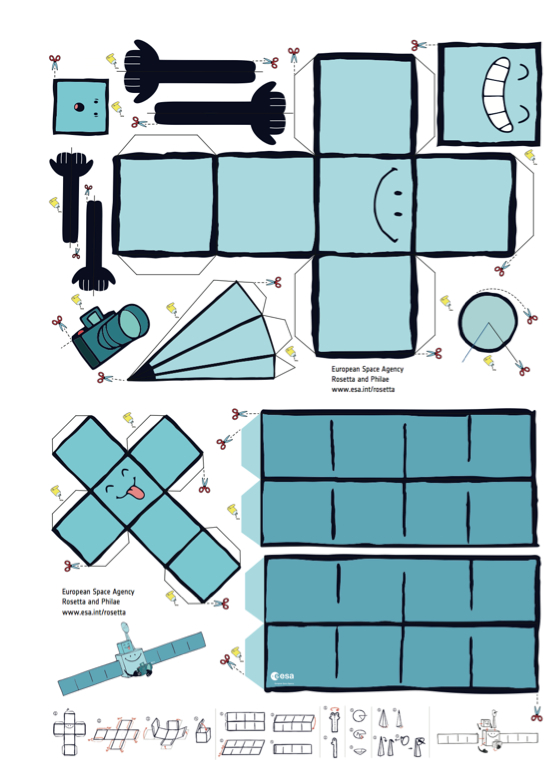
Today, Aug 6th, 2014, the Rosetta Mission reached comet #67P. I learned about this from a Facebook Post by the Jet Propulsion Laboratory.

"Comet countdown! Just a few hours until ESA's Rosetta Mission arrives at‪#‎67P‬. Live coverage starts 1 a.m. PT (4 a.m. ET, 0800 UTC)http://rosetta.esa.int/" ~~ JPL

Being a little late to the party, I wanted to promote a possible home school lesson plan involving the event. I will begin by visiting the site for The Rosetta Mission from the Jet Propulsion Laboratory's Facebook post.


Along the left side of the image you see above, there are a sequence of circles on the Rosetta Mission page. The first circle displays the image above, which is a beautiful and clear images of the comet called #67P. The next circle will take you to a video stream of the media event as Rosetta reached its destination. This is an hour and a 40 minutes of Core Science credit.

However, I think it would be a nicer introduction to the children to begin with the cartoon videos lower in the list. The third button from the top introduces the mission in a cartoon format running 4 minutes. It should be easily digested by even very young children. This provides background and a frame of reference for why we should be interested in the mission.


The fourth button will provide another two and a half minutes. This describes the mounting excitement as Rosetta wakes from her long slumber and prepared for her work. The process of aiming the satellite and adjusting speed and trajectory to match the comet must have required a lot of planing and precision from the European Space Agency. Watching this video helps build a sense of anticipation and importance.


 For a little more detail, the following YouTube video can illustrate some of the degree of planning that goes into such missions. (2 minutes, no words.)


The Rosetta website also provides a link to a visualization of the flight of the Rosetta Mission. It is tucked away under a heading that asks, "Where is Rosetta?" which doesn't reveal the detail found by visiting the link. That is to say, it draws out the flight path of the mission which can further demonstrate the planning and, one hopes, inspire a student with the notion that some great things require a great amount of planning and patience to accomplish. (The child can look for astronomical navigation tricks like what appears to be a gravitational slingshot occurring in the early part of 2005. It might be interesting to ask they child if they can guess what is happening and why.)

The full progress of the visualization takes some time to complete. I don't have a timer to consult, but it appears as if the visualization runs at 1 day per second. The date range from 3/3/2004 to 8/4/2014. This web page allows calculation of a date range. If we trust the results, we come up with 3,806 days. Dividing by 60 results in about 63 minutes to watch the entire path. We should probably assume even the most ardent student will not possess that much patience. I'd time them and give them credit for the time they chose to spend on it, however.

If one wants to hurry past this part (reasonable, I think) you should still check out the Milestones. One of those milestones is Rosetta going into the long sleep mentioned in the video found at the fourth circle on the Rosetta home page referenced above. The following milestone occurs when "Sleeping Beauty" awakes.

The fifth circle continues to build expectation. One could skip this two minutes of "Are we there yet?" if one felt so inclined. I think there is some value in building expectation. For an enjoyable break, you might follow the link labeled "Competition Voting Open." Here you will see the photographs people who were eagerly anticipating Rosetta's arrival submitted for the "Rosetta, are we there yet?" campaign. Some should make you smile. You might also pique the student's interest in a small, related, art project.


Returning to the second circle down from the top, we have now should have sufficient interest raised. With all of the videos added together, we are getting pretty close to a full two hours of video time, all Core Science credit. I will admit that it seems as if the servers may be having some trouble today as I am writing this lesson plan. This might have to do with streaming video over from Europe or it might be an example of demand for the video exceeding the ESA's web server capacity. An alternate link to watch the video (it appears to be the same video) can be found at a LiveStream url. (If you skip ahead to 12:15 seconds in the LiveStream video you can skip a boring waiting period.)

You might be thinking that this is a lot of material to cover. However, from the "Mission" page there is so much more yet to explore.


(If this all seems nice, but a little advanced for your young star-gazer, you might consider allowing them to explore the ESA's general kids website.)


Additional Viewing:
Investigating Comets I Rosetta Mission I Exploratorium (26 minutes)

An entire YouTube Video list related to the Rosetta Mission.


Friday, August 1, 2014

Homeschool Lesson Plan: Social Studies: J. K. Rowling: 3.5 hrs

Amazon Instant Video currently has "Magic Beyond Words: The J. K. Rowling Story" available for streaming for free with Amazon Prime membership. As such, this seems like a fairly good time to have a Social Studies unit on the author.

( http://amazon.com/gp/product/B005DD7SQS  )


The movie will run for 1.5 hours, approximately. The movie has received less than favorable reviews, but one can overcome this with some patience and tolerance. Certainly, it is at an appropriate level for children who wish to see a glimmer into the life of the author of one of their favorite series of books and movies.

J.K. Rowling has her own website which might also bear a review adjacent to or subsequent to the watching of the movie depending on the setup of the home. A parent can load the website and navigate with the left arrow to the beginning of the timeline view. This presents a sequence of stories originating in 1965 when her parents met on a train. Details can be found on the timeline not apparent in the movie.

If your child, like mine, has voiced an interest in being a writer later on in life, they may have a degree of interest yet remaining for this topic. For a slightly different approach, we also have a British Documentary from 2007: J. K. Rowling: A year in the life..." This documentary might be a bit dry for younger audiences. One cannot, however, fault their dedication. (1 hr)


At the end of these three efforts at learning about the author, the student should have a better understanding of the author as a person. I like the idea of assigning a little creative writing as a review. This doesn't have to be particularly well defined. Ideas for the essay might be as follows:

What interesting details of J. K. Rowling's life most appealed to you? Specifically, what do you admire about her?

Rowling's life, like most lives, involves struggles. Her mother's illness. Pressure to pursue a practical or pragmatic career over her love of writing. How one confronts the difficulties in life builds their character. In what ways would you wish to be more like Rowling? 

Have you learned anything about the life of an author or the process of writing? Would a career producing fiction appeal to you based upon what you've seen here?

Not everyone can be a successful writer, the job requires creativity, ability, and persistence. Would you be able to write a full story? Would you worry if people will like it? If so, would those fears keep you from persisting? Even with a good book, selling the idea to a publisher can be challenging and require great patience. Can you see yourself sticking with your dreams despite setbacks? 


The first serious relationship a woman has upon leaving her parent's home can seriously impact her life. She moved away from England to Portugal, why do you think she chose such a move? Her romance and marriage to her first husband went quickly. What caused the relationship to move so quickly and why did it fall apart? 

People are imperfect, they do not always make ideal choices. The consequences of our decisions are not always evident while we are in the process of making life-choices. A gypsy wind blows J. K. Rowling from England to Portugal seeking for some change in life that will make her happy. She has experiences there; Memories are made. Yet, she also finds herself separated from family and friends who might have been able to advise or help. 

Returning to England, she tries to rebuild her life. What obstacles created difficulties for her? What are your thoughts about the public aid system in place? How would you feel if you were in a similar situation? 

Into every life some rain must fall. Some people could have become complacent and resigned to being a part of the system of public assistance. One woman suggests having a second child to make it easier to live 'on the dole.' Certain hurdles made it difficult for Joanne Rowling to work. Her persistence, however, made it work. 

Comparing the style of the movie, the website, and the documentary, which of the three appealed most to you? 

The timeline view allows more personal choice in which areas to explore more deeply. This may be far more interesting because it empowers the learner to focus where their interest is greatest. The the movie tries to present some of the facts with a sense of imagination and drama. The emotional content of such story telling can be more appealing and allow one to have better recall of details after the fact. The documentary will provide the most details, but can seem dry and a bit boring in the slow and methodical approach. It can be important to identify what seems to work best for the individual student. 

Further Options:


Thursday, July 24, 2014

Home School Science: Rainbows, Light, and Optics. Up to 7 hours Core credit.

I always appreciate the efforts made by people of good will to provide educational resources for children on the Internet. Especially, it seems in the area of Science, I often find enjoyable explanations appropriate for children. Today, while browsing Google Plus, I located a video I felt deserved to be passed along. This video runs approximately 10 minutes and explains rainbows and why they appear in arcs.

(The young lady's accent may be Ukrainian, I am not an expert in such matters.)

The young lady in this video has an accent which may be difficult for some people to understand. Of course, you can find other videos to watch.


With another 5 minutes of viewing, perhaps some of  the things said by the young lady in the first video can be reinforced somewhat. Some clarity, perhaps, could be achieved by the absence of a noted accent. However, the second video is a more simplistic explanation of the rainbows and does not cover the same details.

I would be rather remiss, however, to pass over a Bill Nye video.  Bill's speaks for 22 minutes on light and optics in general. During the course of this video, children should be able to understand how and why light bends when it slows down during transmission through glass or water.


During this video, several different experiments are performed in the interest of explaining optics. Perhaps your child could make a note of which ones they think could be performed at home with items you already possess. In particular, the bending of light during the penny trick and the internal reflection with the pencil in a beaker both seem easy and interesting. The later, however, internal reflection, may help make sense of why light would be reflected inside a falling spherical raindrop as explained in our first video. Later in the video, Bill uses a beam of light shining through green water to illustrate that internal reflection depends on the angle at which light hits the water to air boundary. This helps make clear how light can enter what seems to be a clear droplet of water and be reflected in order to create the rainbow.

Finally, although we wander rather far from our original investigation of rainbows, Season 1 Episode 5 of Cosmos: A Spacetime Odyssey contains another 42 minutes of "Core" science time tangentially related to light and optics. With the addition of this episode, our total running time comes to nearly 80 minutes. With 10 minutes to conduct a few of the experiments suggested in the Bill Nye video we should have an hour and a half of science credit.

However, if this is not yet enough coverage of rainbows and related optic phenomenon, your students may be able to to sit through a lecture on the topic by Walter Lewin who holds a PHD in astrophysics and taught at MIT. (He is now retired, a Professor Emeritus.)  His lecture runs nearly two full hours. Walter Lewin's MIT Page provides a few more possibly interesting videos with related content: The Mystery of Light (1 hr 22 min) and Polarization: Light Waves, Rainbows, and Cheap Sunglasses (1 hr 28 min.)

At this point, our resources related to rainbows, light, and optics round out to about 6.5 hours of core science credit for students willing to and able to listen to all the material. Students who take notes during this process should be able to write a half and hour summary of what they learned which was of the greatest interest to them. This is useful to show that the child was paying attention, but also in order to identify what resources most appealed to them.


Friday, May 30, 2014

See something: Say something: Homeschool Lesson: 2.5 hrs non-core

Today's lesson plan can serve to reinforce some of the aspects of the one I presented in "Internet Safety Lesson Plan." Today's website of choice is the Missouri Information Analysis Center. Upon loading this page a video will begin playing regarding terrorism and the role citizens can play in being aware and reporting. The message driving home by the video is, "if you see something, say something." This echoes very nicely the advice to be found from watching the Faux Paws videos in the previous lesson on Internet Safety.

The video will take about 10 minutes to run and should be reasonably entertaining to any child demonstrating a passing interest in shows such as Bones, Criminal Minds, Law & Order, or any of the various CSI programs. When I walk with my daughter, I try to remind her about the difference between public and private spaces. In public, I ask her to keep her eyes and ears open to what is happening around her. In private, in the safety of our home, one can daydream. In open spaces, one must watch for vehicles and people behaving strangely. I reminder her that it is her job to remain in line of sight to me at all times. When she wanders, as children are prone to doing, she gets a talking to about the rules.. again.

"Do you know," I might ask, "if there is an ogre that eats children hiding behind that tree?" She might quip that ogres aren't real. "Just because you haven't seen any monsters yet doesn't mean there aren't any monsters out there." She then might reference that an ogre would be too big to hide behind a tree. To this, my retort might be, "Ok, a small ogre, a baby ogre.."

Having fun is well and good, but there is a serious message behind this. Children do go missing. Sometimes they even go missing from their own house, such as in the case of Elizabeth Smart. Yet even in that case, the awareness, observation, and self control of the sister, Mary, should be seen as quite commendable. The man who abducted her sister spoke softly but with some effort and time Mary was able to identify the voice as that of a man she had met a year before. Truly impressive to identify "Emanuel." Although the police did not think it a reliable lead, a drawing of the face of "Emanuel" on America's Most Wanted proved instrumental to Elizabeth's rescue.

The details of the abduction of Elizabeth Smart were made into a movie, "The Elizabeth Smart Story," with a running time of 120 minutes. It may be a stretch to call this Social Studies and assign "Core" credit hours. A book, however, was also printed Bringing Elizabeth Home (ISBN 978-0385512145) and, as previously indicated, reading is Language Arts and can be treated as "Core" hours. 

I want to teach my daughter the value of being observant and saying something about things she sees or hears which strike her as unusual. I want her to act the way the people at the Missouri Information Analysis Center advice citizens to be as they go about their everyday life in their Video, "See something, say something." All very valuable advice, I believe, I need more time to make this into a lesson.

A second video on the page entitled, "Run. Hide. Fight. Surviving and Active Shooter Event," may be more frightening for children. In this video, a shooter is firing a weapon. There's no blood or bodies, but the focus is different. In the first video, people are planning something bad. In this one, something bad is actually happening. In light of the recent shooting in California by Elliot Rodger in the "2014 Isla Vista Killings," it may seem worthwhile to expose them to some fearful imagery.  It might also be prudent to recall to mind the Aurora Colorado shootings by James Eagan Holmes. The video, "Run. Hide. Fight..." runs for an additional 6 minutes. This extends our lesson to 15 minutes of video.

It would seem reasonable to direct the child's attention at this point to the FBI's most wanted list.  A few minutes could be sent looking at the faces there. From here, one could segue (an irritating word I like to say, but can never seem to remember how to spell)  into looking at a list more worrisome, the kidnap victims. This could bring us around to discussing the show, America's Most Wanted. Once we are on that topic, it would make sense to discuss the case of Adam Walsh, who's father John Walsh afterwards served as the host of the show, America's Most Wanted. From there, we could easily transition to the story of Elizabeth Smart (bio) and how the observations of her sister (see above) when aired on America's Most Wanted aided in the recovery of Elizabeth. A child may be more than a little scared at this point, but we can then explain that bad things do sometimes happen. Despite this, it can be showed, that a person can be motivated like John Walsh to make the world just a little better. We can also reference the Elizabeth Smart Foundation, (Facebook) which she founded in 2011.

For the tech savvy who's children have cell phones, one might consider the Hero (TM) App which Elizabeth Smart has endorsed. (Video)

At this point, by way of some detouring, we have a solid reason for watching the "The Elizabeth Smart Story," (Alternately, you could opt for a 44 minute MSNBC segment) With the original videos and discussion time, we could easily have half an hour of instructional time. Adding the two hours for the movie about Elizabeth Smart would nicely count for two and a half hours. That might be a little long to bear on this topic, but I think we might be helping to drive the importance home and, with luck, perhaps our children will be more aware in public. (Although, hopefully, not agoraphobic.)) 


Elizabeth Smart's Book, "My Story" is available as a Kindle Book from the Amazon store. I also found copies in the catalog for our local library. An audiobook version of this book was available from Overdrive.

Thursday, May 29, 2014

Safety: Internet Safety Lesson Plan: 1 hour core; .5 hour non-core

Internet Safety Lesson Plan: 1 hour core; .5 hour non-core


The official home-school year for my daughter has ended, but I still find things which might be useful as lessons once we get started again. Today, I encountered Surf Safely

Surf Safely seems like a simple enough site put together by the Missouri Attorney General, Chris Koster. I'm sure the Attorney General would very much like to not have to deal with cases where young people share their personal information with the wrong people on the Internet and become a crime statistic. As a site, Surf Safely consists simply of a letter from the Missouri Attorney General and a few links to get you started on your own researches.

The Parents section provides some links for further reading. These links are, of course, going to be my homework. Just peeking at a few links reveals much material to pour over. Even though I like to think I am savvy, aware, and wise; I must confront the fact that the world is a dangerous place and I should not go about blithely assuming the best in human nature. While the unsafe and unsavory may be few and far between, the Internet allows them access with which to throw a wide net. A very real danger exists for children to get caught if they are not told about online safety.

This is an important point for me to take home. Some of my friends seriously restrict their children's access to the internet and computers. As a part of my home schooling of my daughter, I have relied heavily upon internet resources. Reading some of these websites.. it helps get a more careful frame of reference into my head. While I do appreciate the ease of access to wide assortment of information; I have to also inculcate in my child a basic foundation of internet safety.

The links from the Children's section of Chris Koster's site point us in the direction of some resources more directly applicable for children. For example, one of the links takes to me to iKeepSafe Kids which contains some reasonably entertaining videos about "Faux Paws" which might both educate and entertain.

There seem to be 4 videos in this series. As educational material, the stories are available in several formats. The video format might be the most easily digested by children who are not particularly fond of reading. However, I would think that reinforcing the material might be improved by repetition.

First, ask the child watch them the videos.


1. Faux Paw's Adventures in the Internet


2. Faux Paw meets the First Lady


3. Faux Paw Goes to the Games

4. Faux Paw's Dangerous Download

Watching the Videos should take approximately half and hour.  (I believe the time spent watching the video would be considered "non-core" time in Missouri as while we might choose to call it "Computer Science" this seems a bit of a stretch.)

Next, after the child has watched the video, you can have them read the downloaded eBook. They are covering the same material and even children with learning disabilities or dyslexia should be better able to piece together the meaning of the eBook since they have just watched the video. Time spent reading the eBook is Language Arts: Reading. This is "Core" time in Missouri as I understand it. It seems reasonable to allow half an hour for the eBooks to be read.

1. Faux Paw's Adventures in the Internet - PDF
2. Faux Paw meets the First Lady - PDF
3. Faux Paw Goes to the Games - Flash
4. Faux Paw's Dangerous Download - PDF


Having gone over the material twice, now would be a good time to have the child type or hand-write a summary of the material and, optionally, point out any differences they noticed between the two.Where we run our homeschool, this seems to qualify as Language Arts: Writing. As such, you have the material watched, read, and reviewed. It seems to me the review will best let you know what the child learned from the material. Additionally, it could be used as an "Example of Work."

Although a very simple lesson plan, I would expect you can count on 1.5 hours of work. Half an hour of that time would probably be best called: "Non-Core: Internet Safety." The remaining hour of work is split between reading and writing, both falling under the heading of "Core: Language Arts."

After completing their work, if done successfully and any free time remains in the allotted 1.5 hours, perhaps some time playing a safety-related video game from AT&T is a suitable reward.

Safely using the internet,

Preakness Academy